![Customer Success Training and Certification: A Complete Guide [2026]](https://images.unsplash.com/photo-1600880292203-757bb62b4baf?w=1200&h=630&fit=crop)
Customer Success Training and Certification: A Complete Guide [2026]
How to build a customer success training program: CSM onboarding, the competencies that matter, internal certification, and how to keep enablement current as the product changes.

Customer success is one of the last functions to get structured enablement. Sales gets onboarding programs and certification. Support gets scripts and QA. Customer success managers frequently get a product demo, a list of accounts, and encouragement.
That works while the team is small and the product is simple. It stops working the moment you hire the fifth CSM, because there is no shared definition of what good looks like and no way to transfer what your best person knows.
This guide covers building a customer success training program: what to teach, how to sequence it, and how internal certification works when you want proof of competence rather than attendance.
Note that this is about training your own CS team. If you are looking to train your customers on your product, that is a different discipline covered in our customer training programs guide. If you are building frontline support training, see customer service training.
What makes CSM training different
Three things distinguish customer success enablement from sales or support training.
The job is judgment-heavy. A support agent resolves a defined ticket type. A CSM decides whether an account is at risk, what intervention fits, and when to escalate. You cannot script judgment, which means training has to build reasoning rather than procedure.
The knowledge surface is enormous. Product depth, the customer's industry, their internal politics, commercial terms, and the technical integration. A CSM needs working fluency across all of it.
Feedback arrives late. A bad sales call is obvious within a week. A bad customer success relationship shows up at renewal, twelve months later. Without deliberate practice and review, CSMs can develop bad habits for a year before anyone notices.
These push the program toward scenario work, structured practice, and frequent low-stakes assessment rather than content delivery.
The competency model
Before building content, define what a competent CSM at your company can do. Most models cover five areas.
Product depth
Not the demo path. The workflows customers actually get stuck in, the configuration options that matter, and the limitations worth knowing before you promise something.
The test: can they answer a customer's "can it do X" question correctly without checking, including saying no when the answer is no?
Commercial fluency
Contract structure, renewal mechanics, expansion motions, and how pricing works. CSMs who do not understand the commercial model avoid commercial conversations, which is how renewals get surprised.
Account diagnosis
Reading health signals, distinguishing a quiet-but-healthy account from a quiet-and-churning one, and knowing which intervention fits which problem.
This is the hardest competency to train and the most valuable. It is also the one that responds best to case-based practice rather than courses.
Communication under pressure
Delivering bad news, handling an escalation, saying no to a feature request without damaging the relationship, and running an executive business review.
Internal navigation
Knowing when to pull in support, engineering, or the account executive, and how to make that request effectively. New CSMs routinely either escalate everything or nothing.
Structuring CSM onboarding
A workable ramp for a new customer success manager runs about 30 days to first solo account ownership, with real competence continuing to build for a quarter after that.
Days 1 to 5: context. Company, market, customer segments, and the product from a user's perspective. Have them actually use the product to do real tasks rather than watching a walkthrough. The goal is orientation.
Days 6 to 12: product depth and tooling. The workflows customers use most, the admin surface, the integrations, and your internal tools. Assessments here should test application rather than recall, which our online assessments guide covers.
Days 13 to 20: shadowing. Sit in on calls across the account lifecycle: onboarding kickoff, a routine check-in, an at-risk conversation, a renewal. Shadowing is only useful with a debrief afterward where the CSM explains what they observed and why the senior person made each choice.
Days 21 to 30: reverse shadowing with a small book. They run the calls, someone experienced observes and debriefs. Two or three low-complexity accounts.
Day 30 onward: supervised ownership. Full book, scheduled reviews, gradually reducing oversight.
The shadowing and reverse-shadowing phases are where the program either works or does not. Teams that compress them to save ramp time consistently produce CSMs who know the product and cannot run a difficult conversation.
Our employee training plan template gives you a structure to write this down, and new hire onboarding checklist covers the logistics running alongside.
Building an onboarding playbook
The playbook is the artifact that makes CSM onboarding repeatable. It should cover, for each stage of the customer lifecycle:
- What the CSM is trying to achieve at this stage
- The standard sequence of touchpoints
- What to prepare before each one
- The signals that indicate the account is on or off track
- What to do when it is off track
Write it from your best CSM's actual practice rather than from a framework. Sit with them, work through three real accounts, and document what they did and why. That produces a playbook that reflects your business rather than a generic maturity model.
Keep it in your learning platform rather than a document, so it can be assigned, updated centrally, and referenced during work. Our guide on performance support and job aids covers the difference between a reference someone uses and a document they read once.
Internal certification
Certification is worth building when you need proof of competence before someone touches revenue-carrying accounts. It is overhead you should skip if your team is under about five people.
A workable internal certification has three components.
A knowledge assessment. Product and commercial fundamentals, scenario-based. Not a recall quiz. Give them a customer situation and ask what they would do and why.
A demonstration. A recorded or live simulation of a real conversation, typically an at-risk account discussion or a business review. Scored against a rubric by someone experienced.
A rubric everyone can see. The criteria should be published before the assessment. Certification against hidden standards produces anxiety rather than learning.
Issue a certificate on completion so there is a durable record, and set an expiry if your product changes fast enough that competence decays. Recertification on a twelve-month cycle is common. Our certification programs guide covers building and issuing these.
Certificate detail and expiry
A caution: certification measures what the rubric measures. If your rubric rewards polish, you will certify people who present well. Build the rubric around the judgment calls that actually matter, and have two people score independently at first to check it discriminates.
Keeping enablement current
The most common failure is not building the program. It is letting it go stale.
Tie updates to releases. When the product ships something significant, the enablement update ships with it. Make this a step in your release process rather than a good intention. Short-form updates work better than revised courses here, which is the case for microlearning.
Harvest from real accounts. The best training material is a real situation with the identifying details removed. A quarterly practice of turning two hard accounts into case exercises keeps the library grounded.
Run a regular case review. A recurring session where CSMs bring a live account and the group works the problem. This is the highest-return training activity for an experienced team, and it costs an hour. It also surfaces where the playbook is wrong.
Retire content that no longer matches the product. Stale enablement is worse than none, because people follow it.
Tooling
You need somewhere to hold the curriculum, assign it, track completion, and issue certificates. The requirements are modest but specific:
- Role-based assignment so a new CSM automatically receives the ramp curriculum. See role-based training automation.
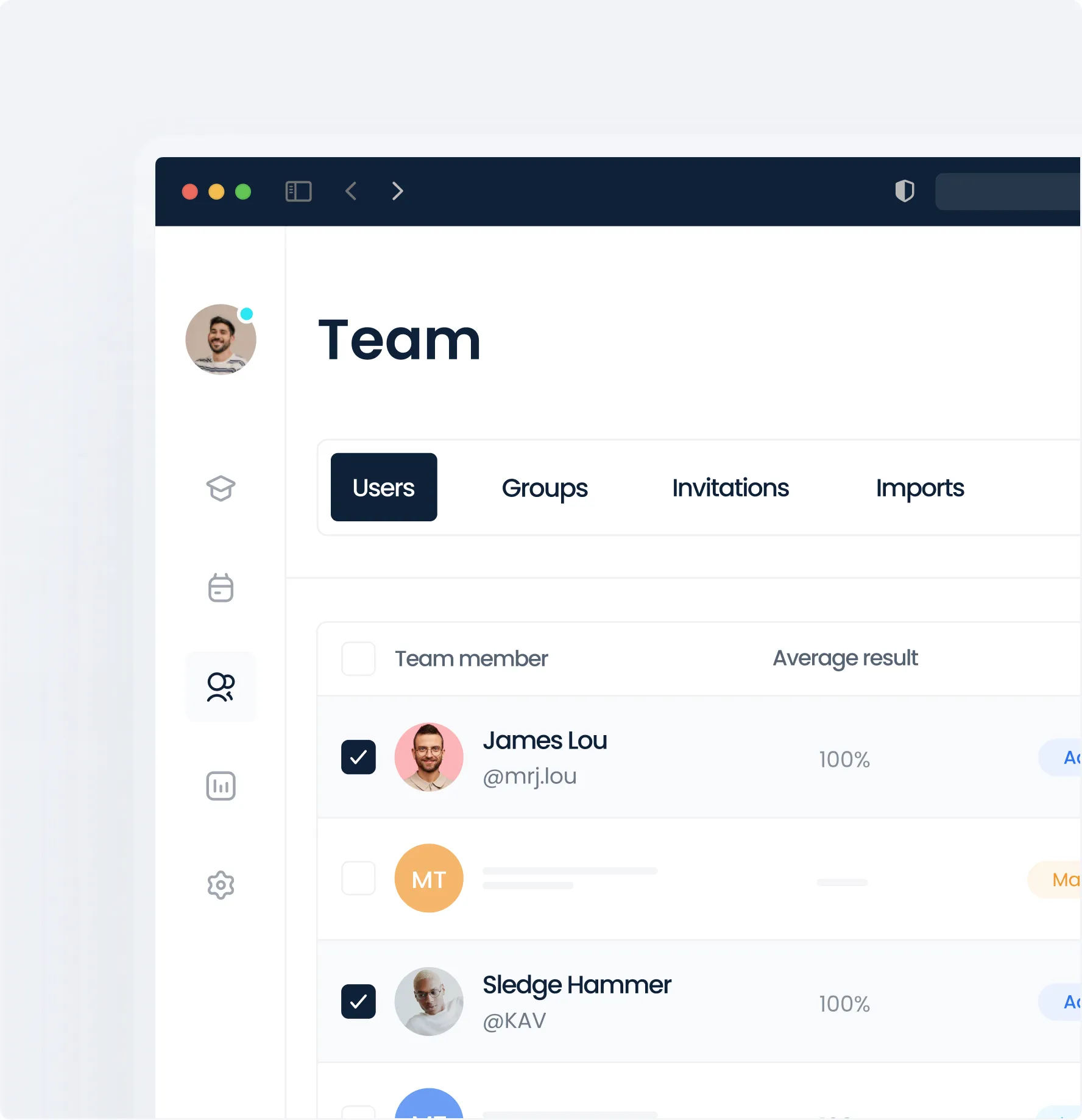 Team management view for a customer success group
- Content you can update quickly, because product changes constantly. Editing in place rather than re-exporting packages is the practical difference. Our course builder works this way.
- Assessments supporting scenario and free-response questions, not just multiple choice.
- Certificates issued on completion, with a retrievable record.
- Reporting a CS leader can check without asking anyone. The analytics page shows the surface.
For teams recording practice conversations, note that video with embedded questions is useful for shadowing debriefs, letting you pause a recorded call and ask what the CSM would do next.
If you are running a small team, our Free plan covers 10 users, which is enough to build and run a CSM ramp before you commit budget. Business is $29/month billed monthly or $24/month billed annually and includes 25 users, with extra seats at $2.75/user/month. All new signups start with a 14-day Business trial.
Measuring whether it worked
Resist judging the program on course completion. Useful signals:
Time to first solo renewal conversation. A concrete ramp measure.
Consistency of account documentation. If CSMs trained under the program record health and next steps in a comparable way, the playbook is landing.
Escalation appropriateness. New CSMs over- or under-escalate. Movement toward the sensible middle is a training effect.
Renewal outcomes over time, with the honest caveat that renewal is affected by product, pricing, and market far more than by enablement. Treat it as a directional signal rather than proof. Our training ROI guide covers making that argument without overstating it.
Start here
If you have nothing today, build in this order: the onboarding playbook first, because it forces you to articulate what good looks like. Then the 30-day ramp curriculum. Then certification, once you have enough people that consistency matters.
Do not start with certification. Certifying against standards you have not yet articulated produces a process that measures compliance with a document nobody believes.
Ready to make customer success enablement repeatable? Start your free trial and build your CSM ramp curriculum this month.