![How to Get Employees Engaged in Training: Practical Strategies [2026]](https://images.unsplash.com/photo-1531482615713-2afd69097998?w=1200&h=630&fit=crop)
How to Get Employees Engaged in Training: Practical Strategies [2026]
Why training engagement drops and what actually fixes it: relevance, timing, format, manager involvement, and the design choices that decide whether people finish.

Low training engagement is usually diagnosed as a motivation problem. People are busy, they do not care, they need more incentive. That diagnosis leads to badges, leaderboards, and reminder emails, which is why so many engagement initiatives produce a brief spike and then the same flat line.
The more useful diagnosis is that engagement is mostly a design outcome. People engage with training that is relevant, arrives when they need it, respects their time, and visibly matters to their manager. When those conditions are absent, no amount of gamification compensates.
This guide covers what actually moves engagement, in rough order of impact.
First, define what you are measuring
"Engagement" collapses several different things. Separate them, because they have different causes.
Start rate. What fraction of assigned people begin. Low start rate is an awareness, relevance, or time problem.
Completion rate. What fraction of starters finish. Low completion is usually a length, difficulty, or format problem.
Depth. Whether people actually attend rather than clicking through. Assessment performance and time-on-content are proxies.
Application. Whether behaviour changes afterward. The only one that ultimately matters.
A program can have excellent completion and zero application. Chasing completion alone produces training optimized for being finished, which is not the same as being useful. Our learning analytics guide covers instrumenting these separately.
The things that actually move engagement
1. Relevance to the job this month
This is the largest factor by a wide margin. People engage with training that solves a problem they currently have. Training assigned because it is on the annual plan competes with actual work and loses.
Practically: connect every course to a specific situation the learner recognizes. Open with the problem, not with learning objectives. "Three ways refund requests go wrong and how to handle each" gets attention that "Refund Policy Module 2" does not.
Where the training is genuinely not urgent for the learner, be honest about that rather than dressing it up. Mandatory compliance training is not going to be thrilling, and pretending otherwise damages credibility for the training that could be.
2. Timing relative to need
Training delivered weeks before someone uses it is forgotten by the time it is relevant. Training delivered at the moment of need is retained because it is immediately applied.
This argues for two things: shorter modules delivered closer to application, and reference material available at the point of work. Our guides on microlearning and performance support and job aids cover each.
The practical version for a busy L&D team: take your largest onboarding course and ask which parts could arrive in week six instead of week one. Usually most of it.
3. Length that matches the content
Long courses have lower completion than short ones, which is unsurprising, but the useful insight is that most long courses are long because of padding rather than substance. Learning objectives slides, recap slides, decorative stock imagery, and background context nobody asked for.
Cut to what changes behaviour. If a module can be fifteen minutes, do not make it forty-five to feel substantial. Where content genuinely needs an hour, break it into sessions with natural stopping points so people can complete something rather than abandoning halfway.
4. Manager involvement
This is the most underused lever available. When a manager mentions the training, asks what someone took from it, and expects it to show up in work, engagement rises without any change to the content.
When the manager never references it, the message is that it does not matter, and learners read that correctly.
Concretely: give managers a short brief for each significant training, telling them what their team is learning and two questions to ask afterward. That is a fifteen-minute artifact with more effect than most content redesigns. Building this capability is covered in our manager training programs guide.
5. Time that is actually available
If training is expected on top of a full workload, engagement is a request for unpaid overtime and people respond accordingly. Organizations that protect learning time get engagement. Those that do not get completion driven by deadline pressure at the last possible moment.
This is a leadership decision rather than a design one, but L&D teams should name it rather than absorbing the blame for a structural problem.
6. Active work rather than passive consumption
Watching a video is comfortable and forgettable. Doing something is uncomfortable and retained.
The design shift is from presenting information to requiring decisions. Scenario questions, branching choices, and short practical exercises produce engagement because they demand attention. A learner who must decide cannot skim.
Our online assessments guide covers writing questions that require judgment, and learning experience design covers the broader shift.
7. Format matched to context
Frontline and field staff on phones need something different from desk workers on laptops. Training that technically loads on mobile but requires pinch-zooming does not get finished on a shift break. See mobile learning.
For distributed teams, the balance between live sessions and asynchronous material matters. Our guides on remote team training and instructor-led virtual training cover the trade-offs.
Where gamification fits
Gamification works for a narrower set of cases than its popularity suggests.
It helps with: repeated practice where volume matters, friendly competition among people who already know each other, and making progress visible in long programs.
It does not help with: content nobody sees the point of, and anything where the extrinsic reward crowds out genuine interest. Points on a course people resent produce resented points.
Used well, the mechanism that matters most is not the leaderboard but progress visibility. People finish things they can see themselves partway through. Our gamification guide covers where it earns its place.
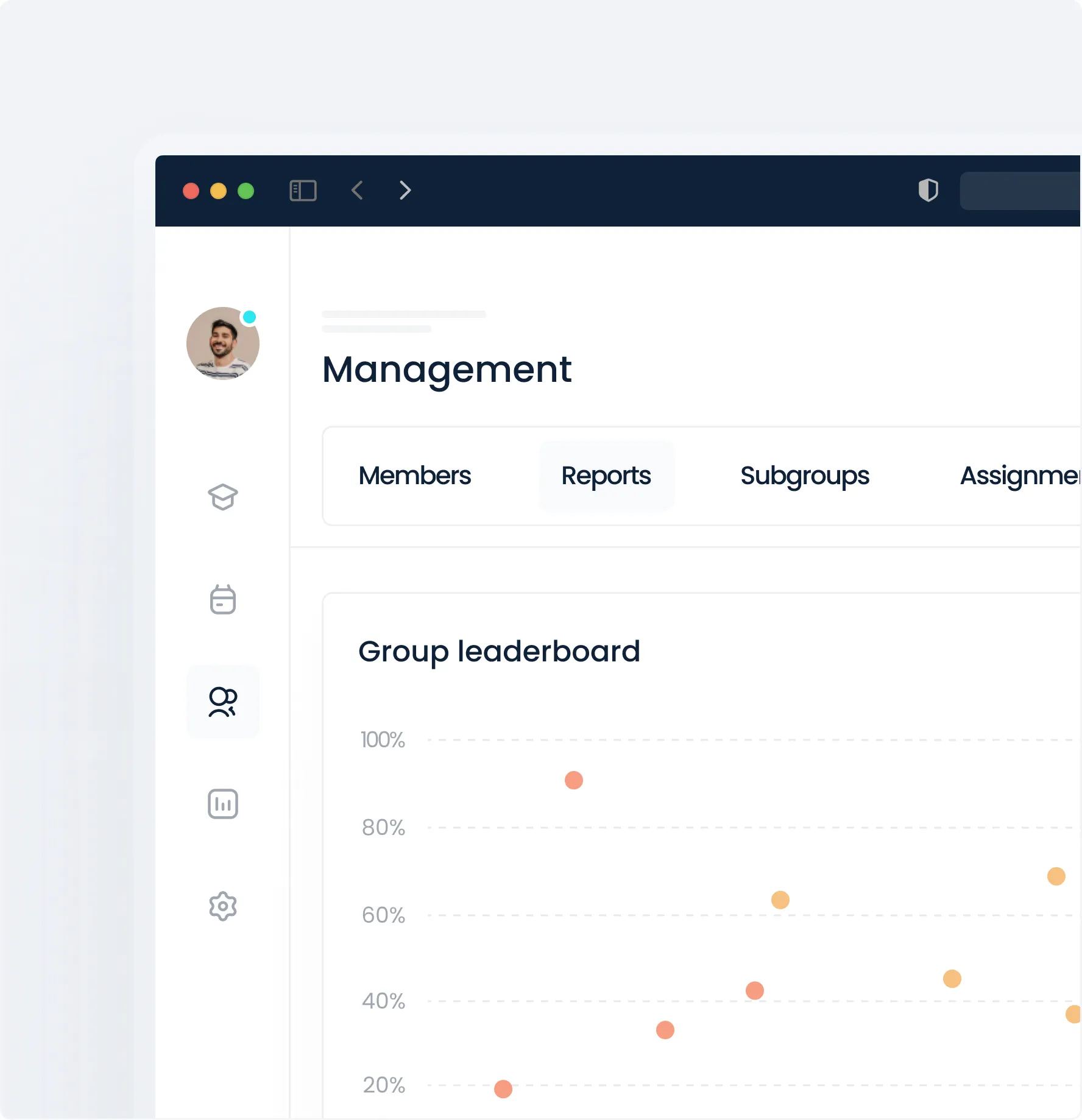 Group leaderboard showing team progress
Making virtual sessions more engaging
Live virtual training has a specific failure mode: it becomes a webinar where cameras are off and attention is elsewhere.
What helps:
Cap the presentation blocks. Ten minutes of talking, then something the group does. The attention curve in a video call is shorter than in a room.
Use structured interaction rather than open invitations. "Any questions?" produces silence. "In the chat, one word for the biggest risk in this scenario" produces responses from everyone.
Small breakout groups with a specific deliverable. Vague discussion prompts waste the time. A concrete task with a reporting-back requirement does not.
Give people something to do with their hands. A worksheet, a template to fill, a decision to record. Passive attendance is the default state of a video call and has to be actively disrupted.
Record for reference but do not treat the recording as equivalent. People who watch the recording did not attend the training, they consumed the content. That is fine, but do not count it as the same thing.
The engagement problems you cannot design around
Some causes are structural and require honesty rather than better content.
Training used as a substitute for management. When a team's problem is an unaddressed performance issue and the response is to assign training to everyone, learners recognize it and disengage. Training does not fix accountability gaps.
Content that contradicts how work actually happens. If the course teaches a process nobody follows because it does not work, learners correctly conclude the training is theatre.
No visible consequence either way. If finishing and not finishing produce identical outcomes, the rational response is not to finish. This does not require punishment, but it does require that completion connects to something: role eligibility, certification, a manager conversation.
Too much of it. Organizations that assign constant training exhaust attention. Fewer, better-targeted programs get more engagement than comprehensive coverage of everything.
A practical diagnostic
If engagement is low and you want to know why, run this before redesigning anything.
Look at where people drop off. If most abandon in the first two minutes, the problem is relevance or framing. If they abandon at forty minutes, it is length. If they finish but fail assessments, they are clicking through, which points to passivity.
Ask ten learners one question. "What would have made this worth your time?" Open-ended, in person or by short message, not a survey with rating scales. The answers are usually specific and actionable.
Check whether managers know it exists. Ask three managers what their team is currently assigned. If they do not know, you have found your highest-return fix.
Compare a mandatory course to a voluntary one. If voluntary content has better completion, your problem is not capability or platform. It is relevance and framing.
Start with one course
Pick the course with the worst completion that people genuinely need. Cut its length by a third, open it with the problem it solves rather than objectives, add two scenario questions requiring a real decision, and brief the managers of the people taking it.
Then compare. That single cycle teaches you more about your organization's engagement drivers than a platform migration, and it takes about a week.
Ready to build training people actually finish? Start your free trial and rebuild your first course around what learners need to decide.