
Training Evaluation Surveys: Questions, Templates, and Pitfalls [2026]
How to write training evaluation surveys that produce usable answers, which questions to drop, and what to measure when a survey cannot tell you what you need.

The standard post-training survey asks whether the session met its objectives, whether the facilitator was knowledgeable, and whether the participant would recommend it. It reliably produces scores between 4.1 and 4.4 out of 5, which tell you nothing and change nothing.
These are often called smile sheets, and the criticism is fair. But the fix is not to abandon reaction surveys. It is to ask questions whose answers could plausibly differ, and to be clear about what a survey can and cannot establish.
This guide covers writing evaluation surveys that produce usable data. For the wider evaluation framework, see our Kirkpatrick model guide.
What a survey can and cannot tell you
Be clear about this before writing questions, because most survey disappointment comes from expecting the wrong thing.
A survey can tell you: whether learners found the content relevant, whether the delivery had practical problems, what they intend to do differently, what confused them, and what was missing.
A survey cannot tell you: whether they learned anything, whether their behaviour will change, or whether the training affected business outcomes. Self-reported learning correlates poorly with actual learning, and self-reported intention correlates weakly with subsequent behaviour.
Those need assessment data, observation, and follow-up respectively. Treating survey scores as evidence of effectiveness is the single most common evaluation mistake, and it leads to programmes that are optimized for being enjoyable.
Questions to drop
"Did the training meet its stated objectives?" Learners have no basis to judge this and will say yes. The objectives were also written by you, so agreement is close to guaranteed.
"Was the facilitator knowledgeable?" Almost universally yes, and it tells you nothing actionable when it is.
"How satisfied were you overall?" Compressed into a narrow band by politeness. The variance is too low to detect problems.
"Would you recommend this to a colleague?" Borrowed from consumer research where the respondent chose to buy. For mandatory training it is meaningless.
Anything asking learners to rate their own learning. People are unreliable judges of what they have learned, and confidence often moves inversely to competence early in a skill.
Dropping these shortens the survey, which raises response rates on the questions that matter.
Questions that work
Relevance and application
"What is one thing you will do differently as a result of this training?"
Open text. The best single question available. Answers that are specific and concrete indicate the training landed. Answers that are vague or restate the course title indicate it did not. Blank answers are also a signal.
"What part of your actual work does this apply to?"
Surfaces mismatches between training content and the learner's real job, which is the most common cause of wasted training.
"What is likely to stop you applying this?"
The most underused question in evaluation. Answers usually name obstacles that are not training problems at all: no time, no authority, the tooling does not support it, the manager does not want it. Those obstacles are the reason training fails to transfer, and you cannot address them if you never ask.
Difficulty and pacing
"Which part was hardest to follow?"
Open text, and far more useful than a difficulty rating. It localizes the problem to a section you can fix.
"Was there anything you already knew that could have been skipped?"
Identifies padding and points toward where a diagnostic and branching would save everyone time. See adaptive learning.
Gaps
"What did you expect to be covered that was not?"
Your content roadmap, written by the people who needed it.
"What question do you still have?"
Direct, actionable, and often reveals a misconception worth addressing in the next revision.
Practical problems
"Did anything technical get in the way?"
Catches the mundane failures that quietly depress completion: video not loading on mobile, content unreadable on a phone, login problems.
Structure and format
Keep it under two minutes. Five to seven questions. Longer surveys get lower response rates and less thoughtful answers, and the marginal question rarely earns its cost.
Lead with the open questions. People answer the first questions most carefully. Put the rating scales last, or omit them.
Use open text more than you think you should. Ratings are easy to aggregate and mostly uninformative. Open text is harder to analyze and where the actionable material is. With small cohorts, reading fifty free-text answers takes twenty minutes and beats any dashboard.
If you use scales, use them for things with real variance. "How relevant was this to your current work?" produces genuine spread. "How satisfied were you?" does not.
Ask at the right moment. Immediately after training for reaction and practical problems. Four to six weeks later for application, which is the only point at which the transfer question can be answered honestly.
The delayed follow-up
The second survey is where most of the value is, and almost nobody sends it.
Four to six weeks after training, ask three questions:
- "Have you used anything from this training? If so, what?"
- "What got in the way?"
- "What would have helped you apply it?"
Response rates are lower than the immediate survey, and the answers are far more informative because they are grounded in whether anything actually happened.
This is also the point where you find out that the training was fine and the environment prevented application, which is a genuinely different problem requiring a different fix. Our learner engagement guide covers the structural barriers.
A reusable template
Immediately after:
- What is one thing you will do differently as a result of this training? (open)
- What part of your work does this apply to? (open)
- Which part was hardest to follow? (open)
- What did you expect to be covered that was not? (open)
- How relevant was this to your current work? (1 to 5)
- Did anything technical get in the way? (open, optional)
Four to six weeks later:
- Have you used anything from this training? What? (open)
- What got in the way? (open)
- What would have helped you apply it? (open)
Adapt the wording, keep the shape. The distinguishing feature is that almost every question has an answer that could surprise you, which is the test a survey question should pass.
What to pair the survey with
A survey is one input. On its own it supports weak conclusions.
Assessment results. Whether people can demonstrate the knowledge, which is a different question from whether they enjoyed learning it. Item-level data is the useful part: if most of the cohort fails the same question, the finding is that your training is wrong, not that your people are. Our assessments guide covers writing questions that discriminate.
Completion and drop-off data. Where people abandon tells you more about content problems than any rating. Early drop-off suggests relevance or framing; late drop-off suggests length. See learning analytics and the analytics page.
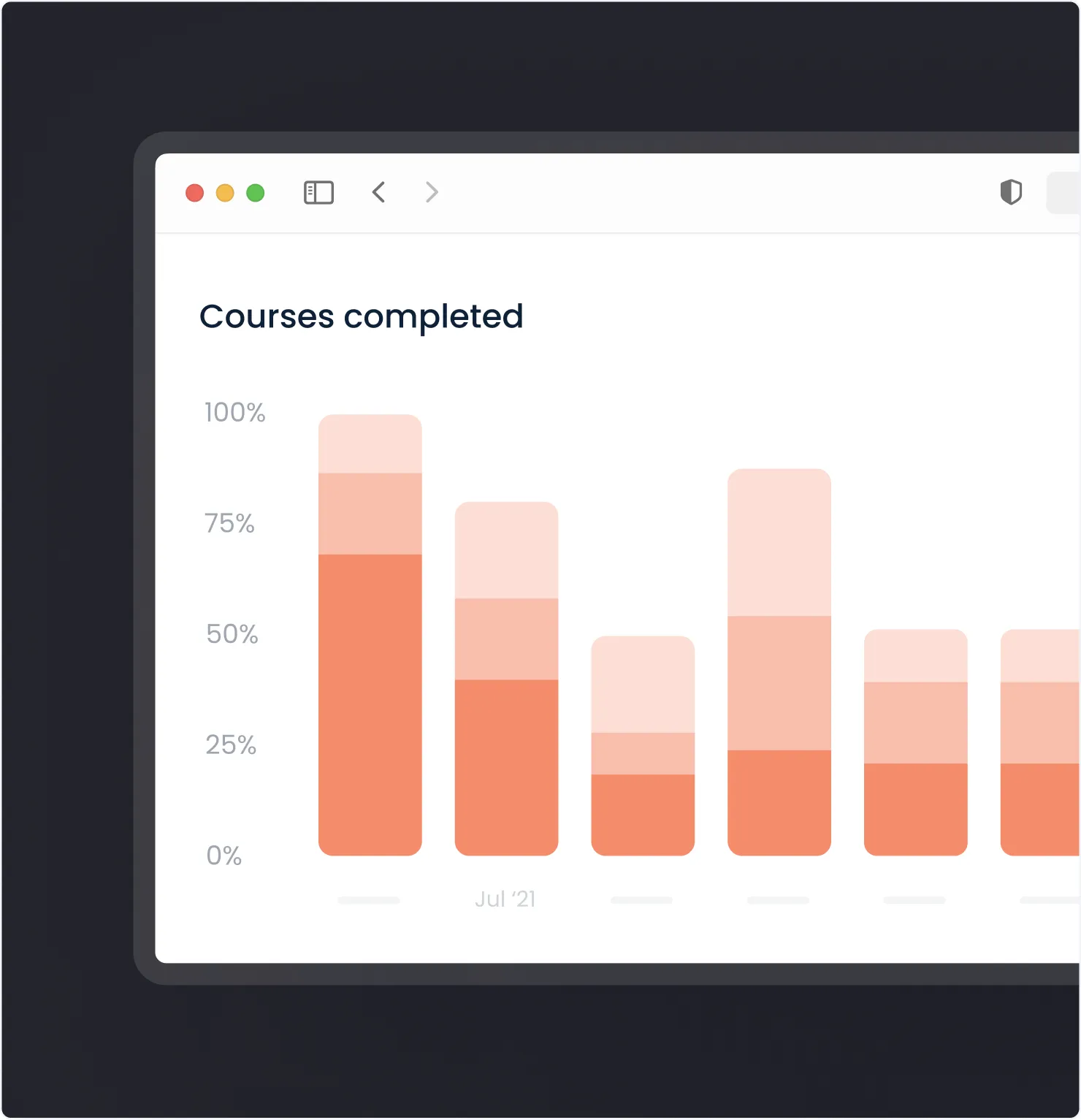 Analytics view showing completion and assessment data
Manager observation. For anything behavioural, the manager is better placed to judge change than the learner. A single question to managers six weeks later, asking what they have noticed, is cheap and more reliable than self-report.
Operational data you already collect. Ticket resolution time, error rates, ramp time. Noisy and affected by many things, but directionally useful when the effect is large.
Analyzing without over-reading
A few cautions.
Small samples do not support precision. With twenty responses, a shift from 4.2 to 4.4 is noise. Report the range and the themes, not the decimal.
Non-response is informative. If half the cohort ignored the survey, that is a signal about engagement, and the half who responded are not representative.
Look for repeated specifics, not averages. Three people independently naming the same confusing section is a stronger finding than any aggregate score.
Separate content problems from environment problems. "The training was unclear" and "I had no opportunity to use it" require entirely different responses, and only the first is your problem to fix in the course.
Closing the loop
The step that determines whether people bother answering next time: tell them what changed.
A short note saying "you told us the section on escalation was confusing, so we rewrote it" costs nothing and does more for future response rates than any incentive. Surveys that visibly produce no change train people not to answer, which is a rational response.
Equally, act on the obstacles. If several people report that they cannot apply the training because of a process constraint, raising that with the process owner is a more valuable output than any content revision.
Ready to evaluate training on something more useful than satisfaction scores? Start your free trial and pair your next course with assessments that show where it actually breaks.